
Blasphemous Turntable: an AI music player between virtual vinyl, pixel art and synthetic discography
A small 1980s-inspired music player becomes an interactive archive for the AI discography of Nevralgia Digitale: a virtual turntable built through vibe coding with ChatGPT Codex, where retro nostalgia, Creative Direction and Generative AI merge into a personal visual and sonic experiment.
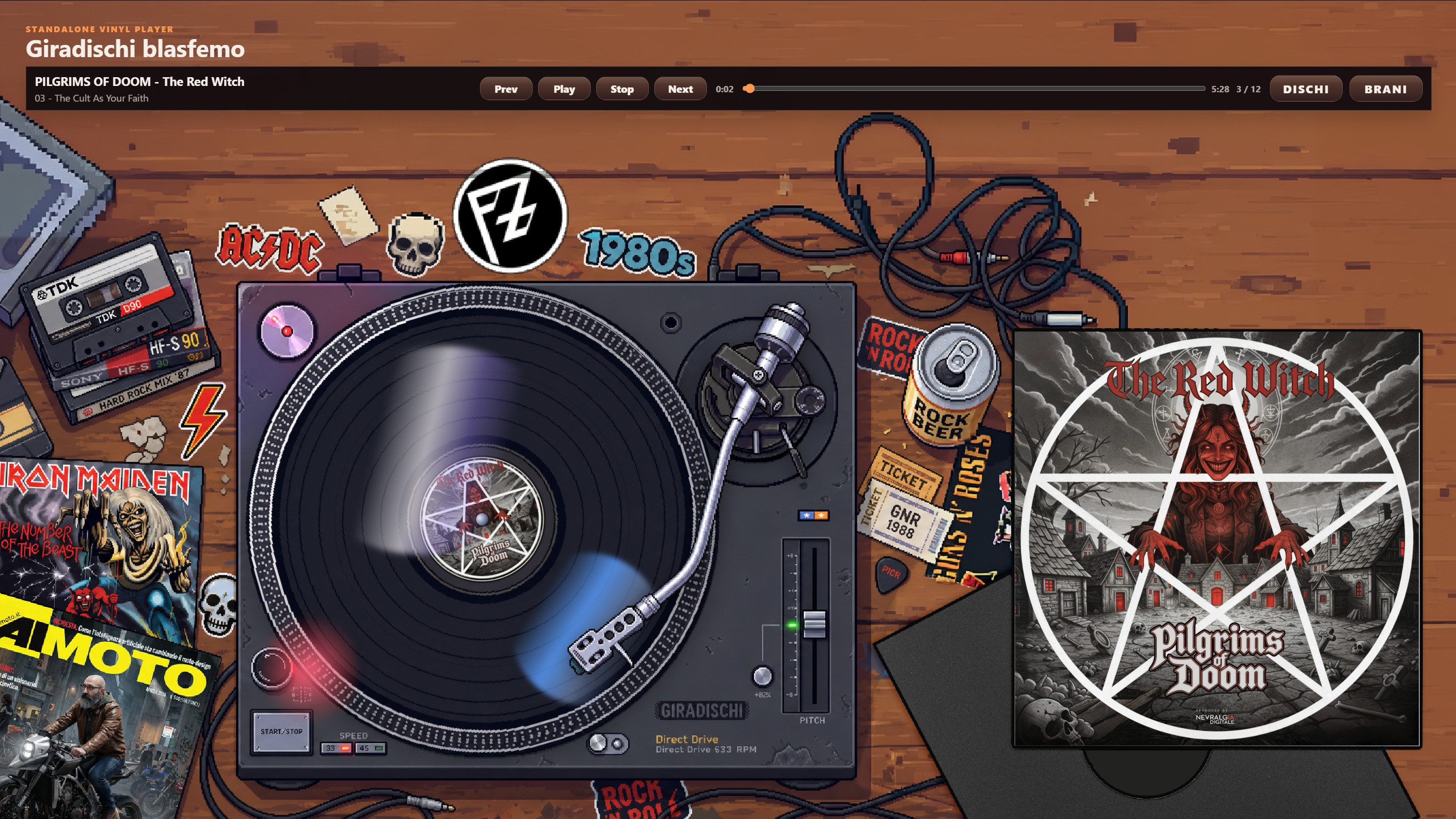
Some digital objects are not designed to solve a massive problem. They are designed to give shape to a mindset. This music player was born exactly from that place: a small personal tool, practical but intentionally unconventional, created to collect and listen to my entire AI discography released as Nevralgia Digitale.
I called it “Giradischi blasfemo” because it does not try to be neutral, polished or invisible. It is a graphic object with a strong attitude: loud, nostalgic, full of visual references to the Eighties, rock culture, cassette tapes, stickers, worn-out album covers, wooden desks, audio cables and all those imperfect details that belong more to memory than to contemporary interface design.
At the center of the project there is a virtual turntable. Not a minimal player with two icons and a progress bar, but a small interactive pixel art scene where listening to music becomes almost physical. Tracks move, covers change, the vinyl spins, and the interface becomes part of the experience. In a time when everything tends to become flat, standardized and functional to the point of anonymity, I wanted to build something with a very specific character.
The player includes all the albums I created with Artificial Intelligence under the name Nevralgia Digitale. It is not just a catalogue. It is a private jukebox, a sonic and visual archive where AI music, rock imagery, pop Visual Culture, retro gaming aesthetics and a personal idea of Creative Technology coexist.
For me, the most interesting part is not only the final result. It is the process behind it. The player was developed through vibe coding with ChatGPT Codex, in an operational dialogue with AI: instructions, tests, corrections, refinements, bugs, visual decisions and small functional details. Not a passive use of the tool, but a continuous collaboration between creative intention, Design, code and Artificial Intelligence.
This is where Generative AI stops being only about producing images or videos and becomes part of a broader Creative Workflow. It is not about pressing a button and waiting for the algorithm to deliver something impressive. It is about building a system, even a small one, that can hold a vision. An interface can become an expanded album cover. A player can become a story. An archive can become an experience.
This approach reflects a lot of my creative identity. I am interested in using AI technologies in original ways, not as aesthetic shortcuts or as replicas of the trends that flood Instagram and LinkedIn every day. Copying the same prompt, generating yet another video of a knife slicing a glass kiwi, or producing a slow-motion girl watching a football game in a stadium does not excite me. Not because those experiments are necessarily wrong, but because they often become repeated formulas, already recognizable and already exhausted the moment they appear.
When AI is used only to follow a visual trend, it risks becoming a machine for accelerated conformity. Everything appears new, but much of it starts to look the same. The same camera movements, the same impossible materials, the same faces, the same effects, the same three-second “wow” designed for the feed.
The more interesting challenge is to use AI Strategy as part of an art direction process. Not just asking what can be generated, but why it is being generated, inside which system, with which tone, with which visual memory, and with what relationship between technology and culture. To me, Innovation is not about chasing the latest effect. It is about understanding how a contemporary tool can interact with formats, rituals and imaginaries that still have something to say.
In this sense, the virtual turntable works as a short circuit. On one side there is nostalgia: vinyl, cassette tapes, covers, Eighties rock, and the almost analog ritual of listening. On the other side there is a fully contemporary production chain: music generated or developed with AI, an interface coded with AI support, and an AI Workflow embedded in both the tool and its aesthetic.
The result is a hybrid object. It is not only a music player, not only a coding experiment, not only a showcase for AI albums. It is a small narrative environment where sound, image and interaction stay together. A way to listen to the Nevralgia Digitale discography without reducing it to a list of files.
This is a direction I find increasingly meaningful: creating personal tools, micro-experiences, interfaces and systems that make the creative thinking behind the content visible. Because today, perhaps, the value is not only in the single output generated by Artificial Intelligence. It is in the way those outputs are organized, contextualized, staged and transformed into experience.
“Giradischi blasfemo” is also a small statement of method. Using AI without being used by its clichés. Entering technology without losing friction, taste, memory and direction. Building digital objects that do not feel like technical demos, but like fragments of a recognizable imaginary.
A music player, after all, can be more than a music player. It can become a miniature manifesto: a way to say that the creative future does not necessarily have to look like a cold, smooth, soulless interface. It can also spin on a pixelated vinyl, full of scratches, stickers, cables, rock covers and Artificial Intelligence. Video at link https://lnkd.in/p/d9TgHK-y
FZ Journal - Exploring Creativity in the Age of AI.